Libera Protocol
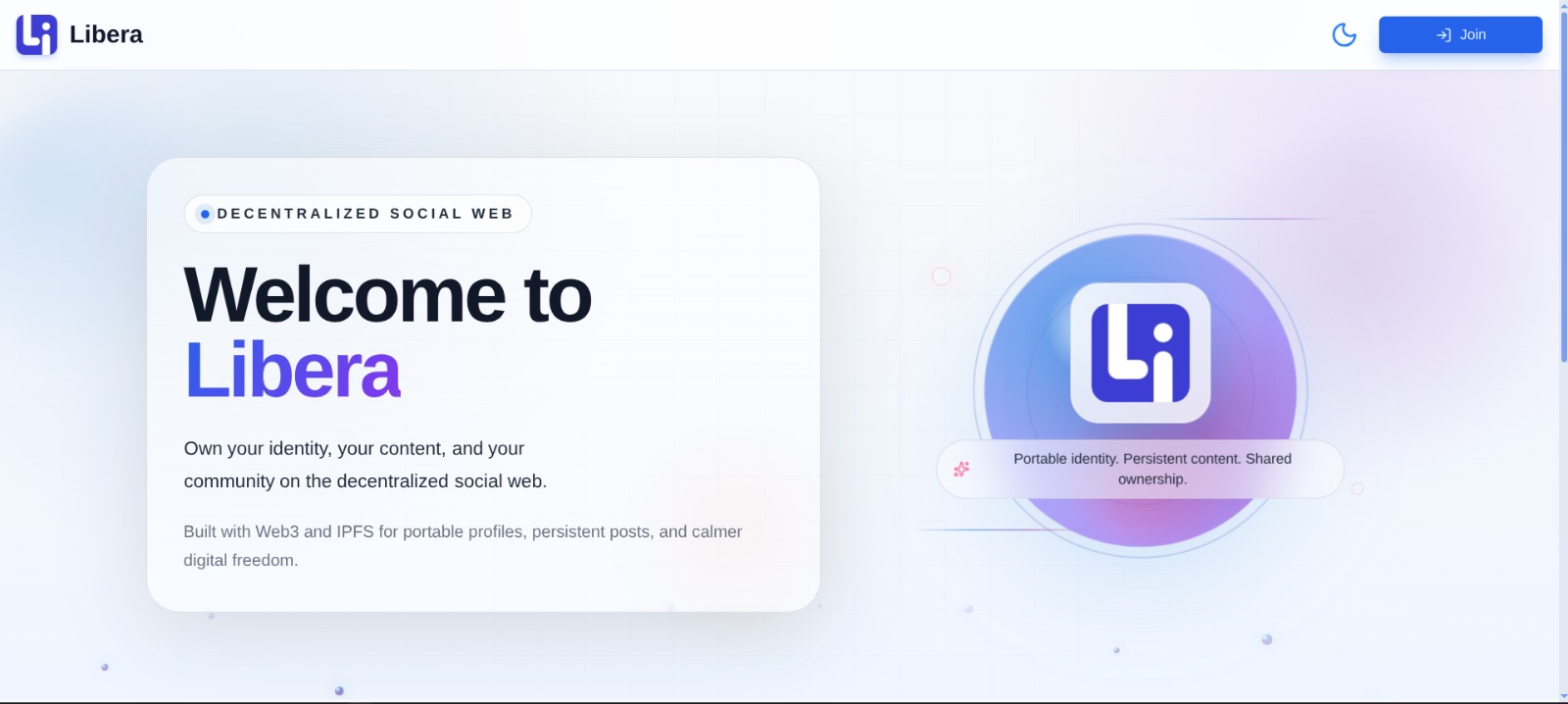
A full-stack decentralized social product combining wallet identity, smart contracts, gasless transactions, IPFS content, and private messaging.
- Role
- Web3 and full-stack developer
- Project type
- Testnet
- Content depth
- Full case study
- Category
- Decentralized Social Protocol
- Core stack
- Next.js, TypeScript, Node.js, Redis, Solidity, Viem, IPFS
01 / Overview
Project overview
Libera is a decentralized social protocol spanning a Next.js application, Node.js services, Redis-backed relayer workflows, IPFS content storage, wallet identity, messaging, and EVM contracts.
02 / Problem
The challenge
Coordinate on-chain identity and governance with responsive off-chain social interactions while keeping transaction and infrastructure states understandable.
03 / Direction
Working hypothesis
If wallet, relay, storage, and messaging states are presented as one coherent flow, users can interact with the decentralized product without needing to understand every underlying service.
Constraints considered
- Blockchain confirmation and failure states differ from conventional API requests.
- Content and messaging span systems with different availability characteristics.
- Gasless interactions require coordination between the client, relayer, and contracts.
04 / Approach
From options to an approach
Map the complete interaction path
Identity, transaction, content, and messaging responsibilities were separated so every boundary had explicit loading, success, and failure behavior.
Use typed integration layers
Contract calls, relayer requests, and storage operations were isolated behind typed interfaces instead of being embedded in presentation components.
Design recoverable states
The product flow accounted for rejected signatures, delayed confirmations, unavailable content, and retryable service operations.
05 / Build
Implementation
- Built wallet-based identity and smart-contract integrations with Viem and TypeScript.
- Implemented gasless transaction relayer flows backed by Node.js and Redis services.
- Connected IPFS content storage and decentralized messaging features to the UI.
- Integrated token and governance contracts deployed to Optimism Sepolia.
06 / Validation
How the work was checked
- Exercised transaction flows against public testnet deployments.
- Checked wallet rejection, pending transaction, confirmation, and service error paths.
- Used explorer-visible contracts as independently inspectable implementation proof.
07 / Outcome
What was delivered
- Delivered an integrated testnet product across application and protocol layers.
- Created reusable boundaries for wallet, contract, relayer, and content operations.
- Made core token and governance deployments publicly inspectable.
08 / Reflection
Learnings and limitations
- Web3 UX improves when network details are translated into clear product states.
- Typed boundaries reduce the cost of changing contracts or infrastructure.
- A production launch would still require independent security review and wider user testing.
Evidence